
PFAS limits and migration are two different evidence lines.
From 12 August 2026, Regulation (EU) 2025/40 applies defined PFAS concentration limits to food-contact packaging placed on the EU market: 25 ppb for an individual PFAS by targeted analysis, 250 ppb for the sum of targeted PFAS and 50 ppm for PFAS including polymeric PFAS, subject to the regulation’s conditions.
Food-contact paper articles must also be safe and sufficiently inert under Regulation (EC) No 1935/2004. PFAS analysis asks what fluorinated substances may be present; migration or extractables testing asks what can transfer under defined contact conditions. One result should not be used as a substitute for the other.
Traditional varnish is not automatically wrong—but its original brief may be too narrow.
Many legacy paper-plate varnishes were selected for print appearance, gloss, basic moisture resistance, cost and stable converting. That does not make every traditional varnish non-compliant. It does mean the material may not have been designed around today’s combined PFAS, food-contact and customer-documentation questions.
When the formulation, supply-chain traceability or finished-article evidence is incomplete, simply repeating that a varnish has been used for years is not enough. The relevant question is whether the exact current construction has suitable evidence for its intended market and food-contact conditions.
A new coating can quietly become a new manufacturing process.
A new functional coating may change viscosity, wetting, coat weight, drying temperature, line speed, blocking behaviour, print appearance and forming performance. If it only works through unfamiliar application equipment or a redesigned production sequence, adoption becomes a capital and operations project—not just a material purchase.
That is why converters need more than a promising laboratory formulation. They need a coating that can be introduced with manageable trials, clear process windows and realistic control points on the equipment they already understand.
Our answer is a new material designed for a familiar process.
LVTU GT-011 is a water-based, fluorine-free functional coating developed for paper food-contact applications. Its project value is that it can replace the varnish step while retaining the converter’s core traditional coating and converting route, subject to line trials and agreed process parameters.
In other words, the material response can change without forcing the factory to reinvent the whole production system. Final coat weight, drying, print compatibility, forming performance and resistance targets still need to be confirmed on the actual paper and line.
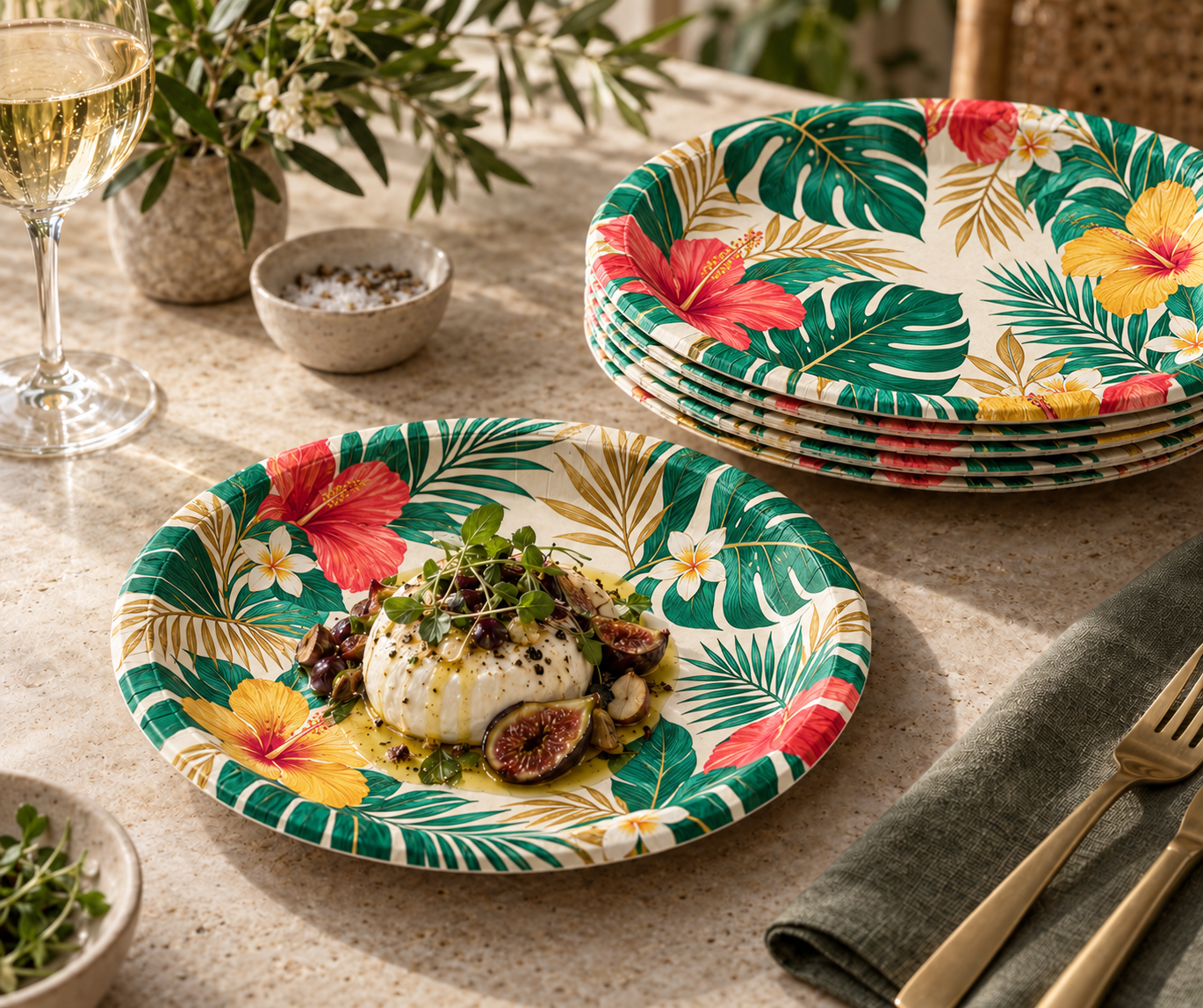
The promise has been tested on a customer’s finished paper plates.
A customer used our coating to manufacture finished paper plates and submitted those plates for third-party testing related to EU migration and extractables requirements. The report covered overall-migration-related evaluation under EN 1186-3:2022 conditions, including defined food simulants such as 3% acetic acid, ethanol-based simulants and isooctane. The tested project was reported as compliant for its stated conditions.
That is verifiable project evidence, not a universal certificate for every paper, ink, process or food type. New combinations should still be reviewed and, where appropriate, tested as finished articles under the conditions relevant to their intended use.
The practical route is material, process and evidence together.
For an EU paper-plate project, define the plate construction, inks, coating, food types, temperature and contact time first. Then map PFAS evidence, migration or extractables testing and line trials to that exact construction.
The goal is not to replace one slogan with another. It is to give converters a new functional material that can respond to new requirements through a familiar production route—and to support the claim with evidence that belongs to the finished project.