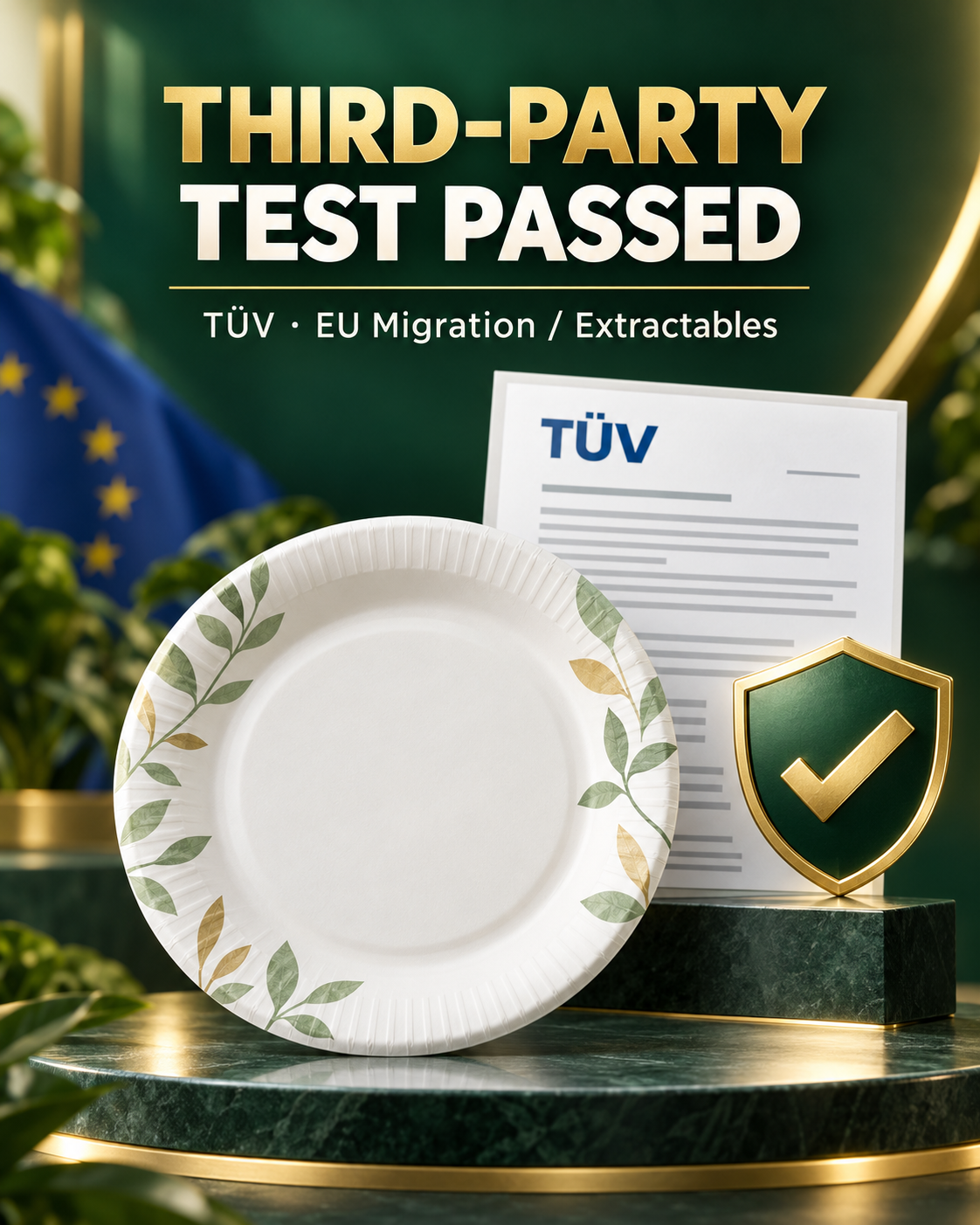
A milestone built on finished-article evidence.
A European customer used LVTU water-based functional coating as the barrier layer on printed paper plates and introduced it through the customer’s established converting route. The finished plates—not only the coating liquid—were then submitted to TÜV for independent third-party testing.
That distinction matters. Paper, ink, coating, coat weight, drying and forming conditions work as one finished-article system. Evidence on the complete plate therefore gives the project a much stronger decision basis than a stand-alone raw-material statement.
What was verified in this customer project?
According to the project results, the tested finished articles completed the EU-oriented migration/extractables assessment under relevant EN 1186-3:2022 conditions and passed the acceptance criteria defined for this project. The finished articles also met the PFAS control requirements specified for the customer project.
The applicable food simulants, contact time, test temperature, analytical limits and final judgement remain those stated in the formal TÜV report. This is project-specific finished-article evidence—not an unconditional certification for every possible paper, ink, coat weight or food-contact use.
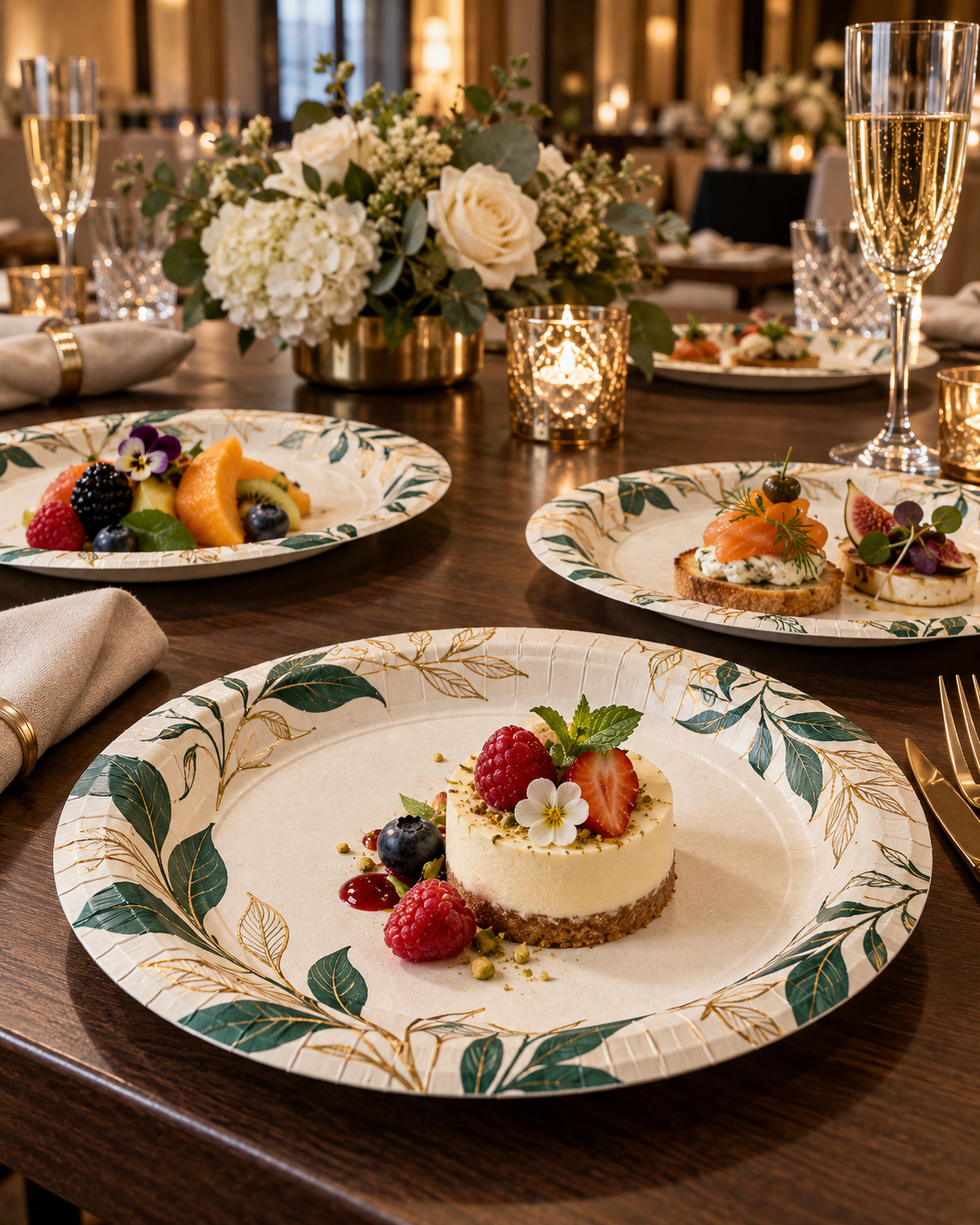
The material changed; the core production route stayed familiar.
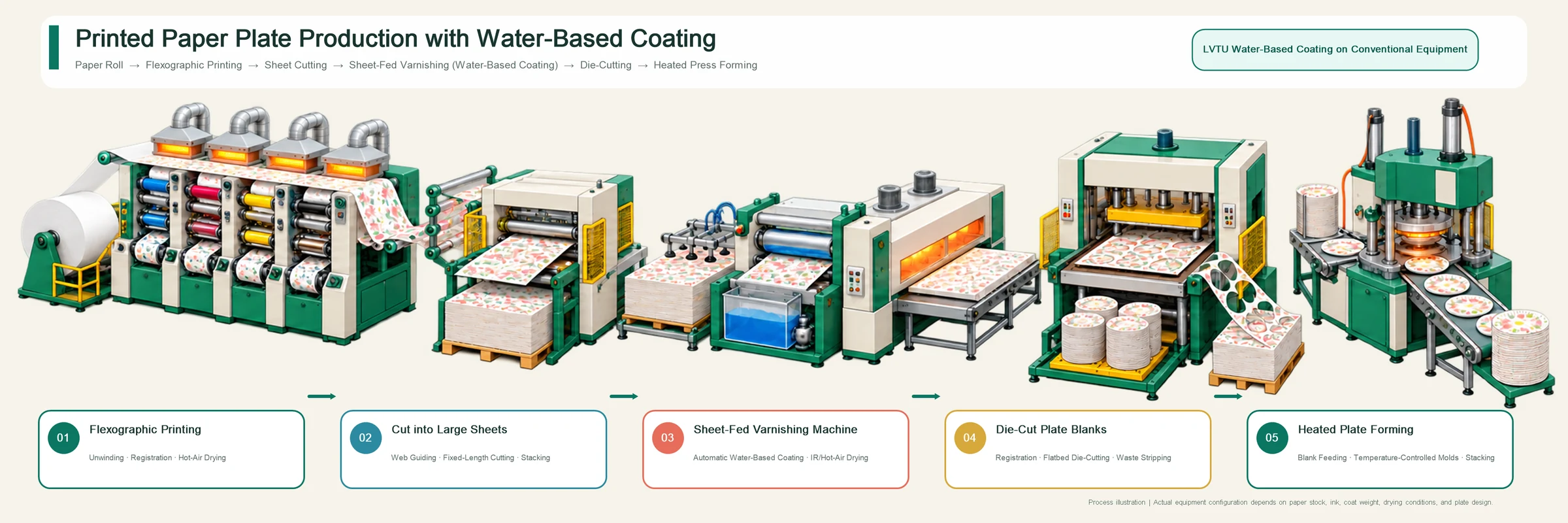
The project retained the core sequence of roll printing, cutting into large sheets, sheet-fed water-based coating, die-cutting and heated plate forming. The factory still needed to confirm coating weight, drying capacity, line speed and forming parameters, but it did not have to replace the entire production logic with a dedicated new converting route.
This is the practical value of the coating approach: the new barrier function can be evaluated within a mature operating environment, using equipment and process knowledge already familiar to the converter.
The commercial reality: approximately 5–8% higher cost.
Compared with the customer’s previous film-laminated route, the total production cost of the water-based coating solution increased by approximately 5–8%. It was not a zero-cost upgrade, but the increase remained within the customer’s acceptable range.
In return, the customer gained a route without an additional laminated film structure, supported by third-party finished-article evidence and compatible with established production equipment. The 5–8% figure belongs to this customer project and should not be treated as a universal quotation for every substrate, line or specification.
From one successful project to a repeatable validation path.
We thank our European customer for the work invested in line trials, parameter optimisation and finished-article validation. Material innovation becomes commercially meaningful only when it performs on a real production line and stands up to real testing.
LVTU welcomes paper-plate manufacturers and sheet-fed coating processors to arrange production trials. Project phone: +86 156 5560 0006. WhatsApp Business: +86 181 7737 8866. Business inquiries: lee@lvtupack.com.