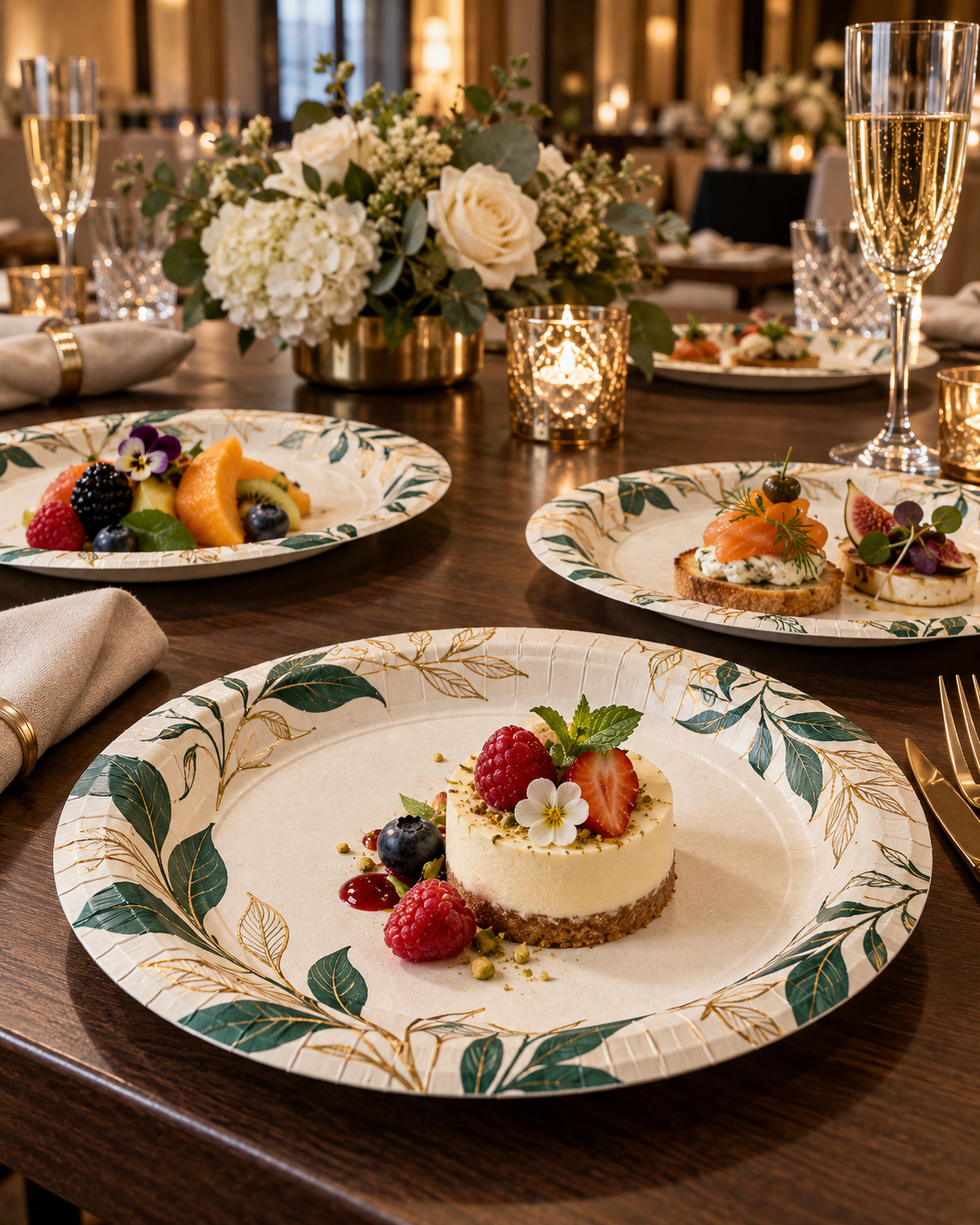
A paper plate surface now has to do more than look finished.
Conventional paper-plate varnish was commonly selected to smooth the surface, protect the printed layer and reduce rubbing during stacking, transport and use. It remains a mature and economical process. The problem is not that every traditional varnish is automatically unsuitable; it is that many legacy systems were not originally developed around today’s PFAS limits, food-simulant migration questions and finished-article documentation expectations.
Gloss is not the same as barrier performance, and a raw-material statement is not the same as a finished-product result. Paper, ink, coating, coat weight and drying conditions work as one construction. When the use changes—from dry snacks to greasy, acidic, alcohol-containing or hot food—the relevant evidence may change as well.
Film can improve barrier performance—but it changes the material structure.
Lamination and extrusion coating introduced a more continuous film layer. For a defined project, that can help improve resistance to grease and moisture and reduce direct contact between food, printing and paper. It can also make some migration or extractables targets easier to manage within a specified construction.
The trade-off is a paper-and-plastic structure that may complicate repulping, recycling or degradation routes. For buyers seeking less plastic or a plastic-film-free paper plate, adding another film is not always the desired answer. Any end-of-life or “plastic-free” claim still has to be supported by the complete formulation, final article and destination-market requirements.
Why does a new coating often bring a new process?
A coating change is not simply one drum replacing another. Viscosity, surface tension, wetting, target coat weight, drying temperature and curing window may all change. A converter may then need a different application system, more dryer capacity, a lower line speed, operator retraining and a new quality-control window.
If the material only works after major equipment changes, the business cost includes capital expenditure, downtime, early-stage yield risk and the need to revalidate printing, die-cutting and forming. A useful material upgrade therefore has to address both the new requirement and the reality of the installed production line.
LVTU’s route keeps the core paper-plate process in place.
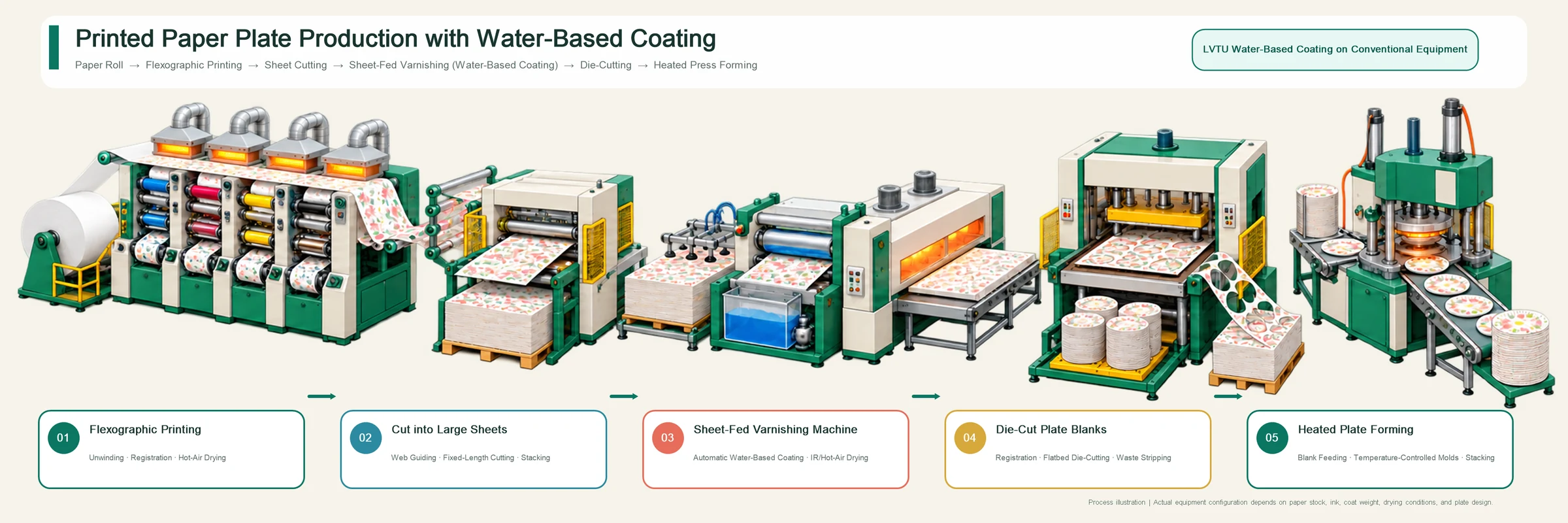
LVTU GT-011 is a water-based, fluorine-free functional coating developed for paper plates, bowls, food boxes and related paper tableware. Subject to project trials and agreed process parameters, it is designed to be applied through the converter’s existing printing, sheet cutting, sheet-fed varnishing, die-cutting and heated plate-forming route.
The process starts with a white paper roll. The web is flexographically printed and dried, cut into large sheets, coated on a conventional sheet-fed varnishing machine, dried again, die-cut into round blanks and finally formed in heated molds. The material changes; the core manufacturing sequence remains familiar.
The migration evidence belongs to the tested finished article.
A customer used the LVTU coating to manufacture finished paper plates and submitted the articles to a third-party laboratory for EU-oriented migration or extractables evaluation. According to the available report summary, the project was evaluated under relevant EN 1186-3:2022 conditions and covered four migration/extractables items: one using 3% acetic acid, two using ethanol-based food simulants and one using isooctane. All four results met the acceptance requirements for that tested project.
That is verifiable finished-article evidence—not a universal certificate for every substrate, ink, coat weight, food, temperature or European market. Reproduction requires the relevant production parameters and intended-use conditions to be defined and, where necessary, confirmed again on the final article.
“Water-based” and “plastic-film-free” still need defined boundaries.
A water-based coating can support a route away from lamination or extrusion-coated plastic film, but water-based does not automatically mean biodegradable, compostable, universally recyclable or free of every polymeric component. Those conclusions depend on the complete formulation, coat weight, paper construction, collection or treatment route and the evidence required in the destination market.
The more accurate project question is whether the selected coating and final paper plate can meet the customer’s defined plastic-reduction or plastic-film-free specification while also delivering the required food-contact, barrier and production performance.
Start the project with six defined inputs.
A useful trial starts with the paper type and grammage; ink and current varnish system; intended food type; contact time and temperature; coating method, dryer capacity and line speed; and the destination market with its required PFAS and migration test list.
With those inputs, LVTU can help evaluate GT-011 compatibility, define trial parameters and map the finished-article test plan. New requirements do not always require a new production line. Sometimes the more practical answer is a new material that lets the proven process keep working.
LVTU welcomes sheet-fed varnishing and coating processors, as well as paper plate manufacturers in all regions, to arrange on-line trials. Project contact: +86 156 5560 0006.