Trust begins after the claim.
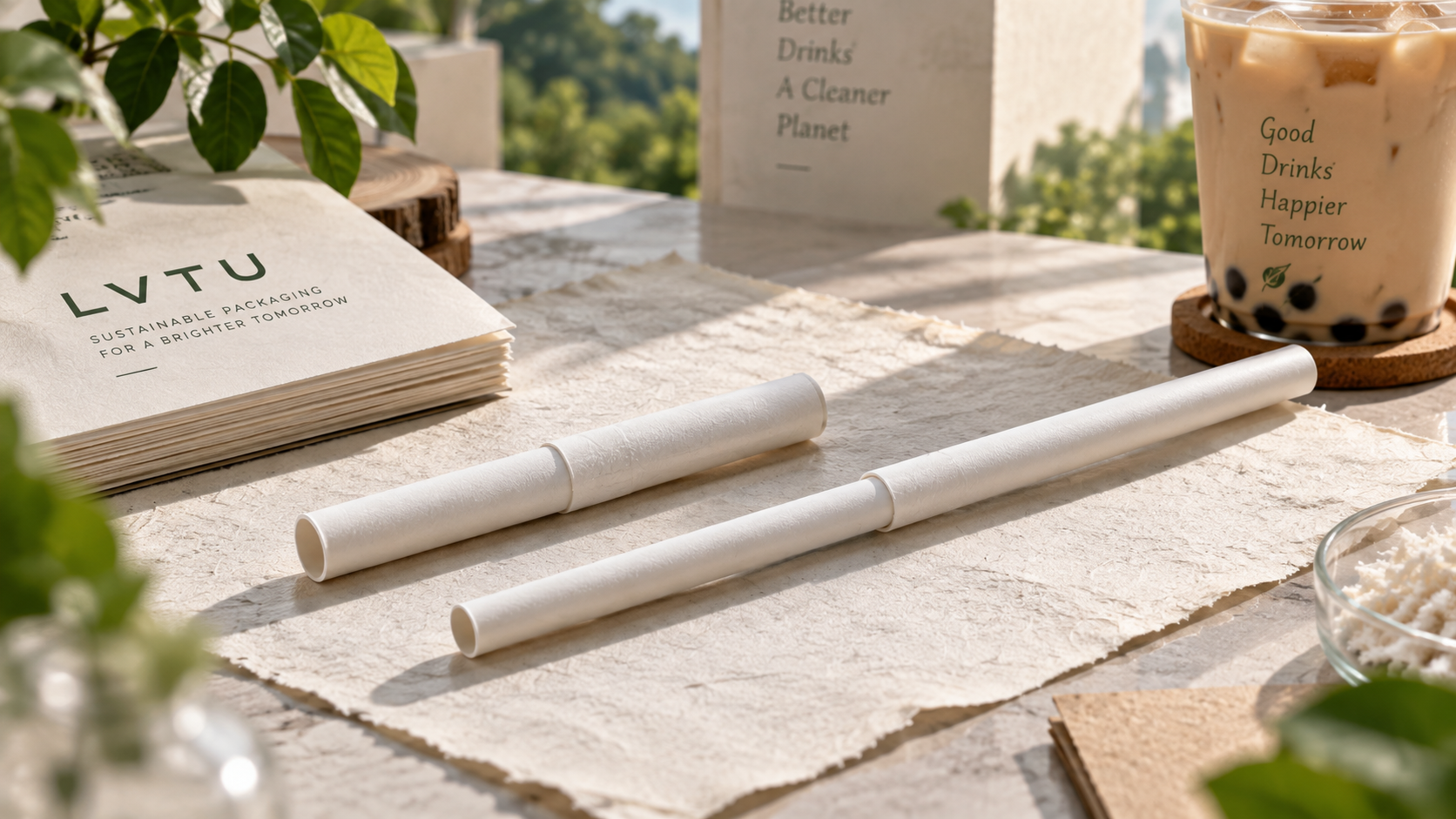
When we began developing a 12 mm telescopic paper straw, the first questions were practical: does the inner tube extend smoothly, does the connection stay secure, does it still feel right in a cold drink, and can the packed format stay short without forcing a customer to redesign the entire cup system?
Then overseas buyers—especially those serving Europe—started asking about PFAS. The useful question was no longer only “Is it PFAS free?” It was “How do you know?” That is the question a responsible food-contact product should be able to answer.
Paper does not automatically mean simple.
A telescopic straw can look straightforward: an outer paper tube, an inner paper tube and a physical connection. But food-contact decisions also depend on the things that are not obvious from the outside—paper specification, coatings, upstream adhesives, converting controls and whether a report still represents the material currently being supplied.
A stack of reports is not the same thing as traceability. A better question is: which exact material does this report belong to, and what question was the test designed to answer?

PFAS Free is a starting point, not a conclusion.
For food-contact packaging placed on the EU market, Regulation (EU) 2025/40 introduced PFAS concentration limits from 12 August 2026. The rule sets defined thresholds and does not replace the need to understand the actual material, the applicable test method and the supply chain for a specific project.
As more suppliers use the words “PFAS Free”, the phrase alone becomes less useful. Buyers still need to ask who tested the material, when it was tested, what the detection or reporting conditions were, and whether the tested material still represents current production.
The hidden cost of unclear documentation.
We call this “compliance debt”—not a legal term, but a useful way to describe accumulated uncertainty. An unexplained coating, a raw-material change without refreshed documentation, or an old report that no longer maps clearly to production can all add uncertainty to a project.
A telescopic function comes from a visible physical relationship between two paper tubes. That does not make a product automatically compliant. It does make the structure easier to describe, the questions easier to see and the material path easier to examine.
Standards are useful when they answer the right question.
A common search phrase contains the typo “FPAS”, but the correct abbreviation is PFAS. There is also no universal certificate simply called a “PFAS standard”. A more accurate project statement is that the material is evaluated against the PFAS requirements applicable to its target market, with relevant material information and test evidence supplied where needed.
The same discipline applies to EN 1186-3:2022. It specifies a method for measuring overall migration of plastic food-contact materials and articles using evaporable food simulants. It may be relevant to an applicable component or assessment, but it should not be presented as a universal certification for a paper straw.
Less uncertainty is the next stage of sustainability.
LVTU does not want to compete only by repeating words such as green, biodegradable or sustainable. The harder thing to copy is clarity: what the structure is, what the main materials are, what a document proves, what has been verified, and what still needs to be confirmed for the intended application.
For a 12 mm telescopic paper straw, that is the standard we want to build toward: not louder environmental claims, but fewer unanswered questions.