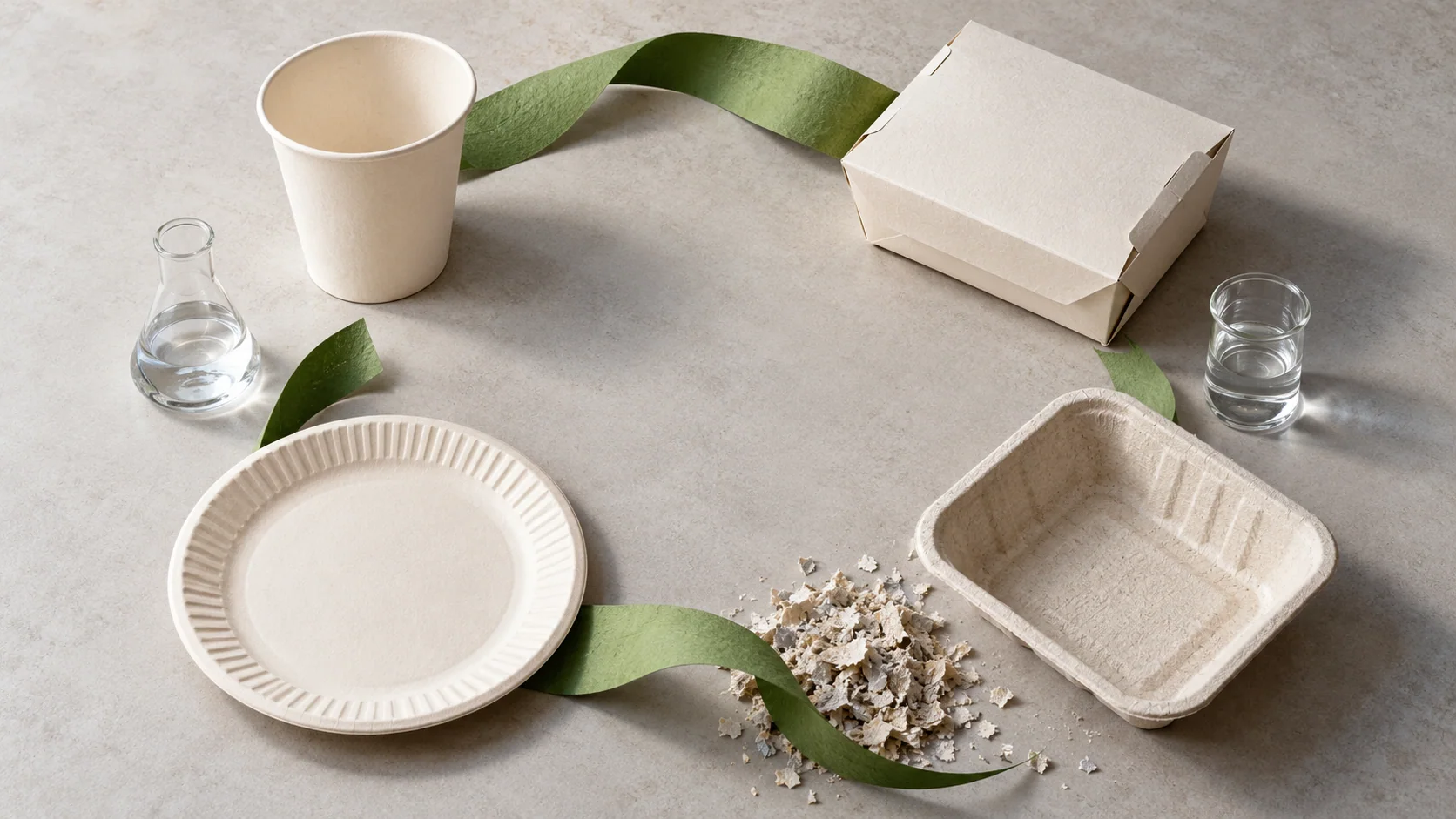
PPWR changes the question from claim to proof.
Regulation (EU) 2025/40 on Packaging and Packaging Waste—the PPWR—has applied across the European Union since 12 August 2026.
For the paper food-packaging industry, PPWR is not simply a request to replace plastic with paper or to add “sustainable” and “recyclable” to a product description. Its logic is more demanding: why does this packaging structure comply, where is the evidence, and who can provide the complete file when an authority asks?
1. Start by confirming whether the item is “packaging” under PPWR.
PPWR applies to packaging, not automatically to every single-use foodservice article. A disposable paper plate or cup designed to be filled at the point of sale may qualify as service packaging. A disposable plate sold empty and not intended to be filled at the point of sale is listed in Annex I as a non-packaging item. A standalone paper straw would also not normally become packaging merely because of its use.
The most direct PPWR applications for our coating technology are therefore paper cups, food boxes, trays, wraps and point-of-sale-filled paper plates. Paper straws remain subject to applicable food-contact and product rules, but a claim about a straw should not automatically be presented as proof of PPWR packaging compliance.
2. PFAS limits for food-contact packaging are already applicable.
Since 12 August 2026, food-contact packaging cannot be placed on the EU market at or above any of the following thresholds: 25 ppb for any individual PFAS measured by targeted analysis, excluding polymeric PFAS from that quantification; 250 ppb for the sum of targeted PFAS, where applicable after degradation of precursors; and 50 ppm for total PFAS, including polymeric PFAS. Where total fluorine exceeds 50 mg/kg, evidence may be required to distinguish fluorine from PFAS and non-PFAS sources.
The Commission’s 2026 guidance recommends a stepwise enforcement approach: total-fluorine screening first, differentiation between organic and inorganic fluorine where necessary, and further analysis such as direct TOP testing when the targeted limits must be assessed.
“No intentionally added PFAS” is therefore not automatically the same as PPWR compliance. Supplier statements, screening data, analytical methods and finished-packaging test results should form part of the technical file.
3. Recyclability becomes progressively more demanding.
Article 6 establishes that packaging placed on the market must be recyclable. The general requirement applies from 12 August 2026. From 2030, packaging will be assessed against EU design-for-recycling criteria and must achieve grade A, B or C; below 70% will be considered technically non-recyclable. From 2035, recycled-at-scale performance is added. From 2038, grade C packaging will no longer be allowed on the market, so packaging will in principle need to achieve at least grade B.
For coated paper packaging, paper content alone is not sufficient evidence. The coating, ink, adhesive and other components must be considered for fibre separation, sorting, repulping and the quality of the recovered fibre.
4. Weight and volume must be minimised—and “water-based” is not a legal shortcut.
From 2030, manufacturers and importers must reduce packaging weight and volume to the minimum necessary to perform its functions. A coating route that achieves the required barrier at a controlled coat weight and avoids an additional film layer may support this assessment, but the conclusion must be backed by structural and functional data.
Water is the application medium. It does not determine whether every film-forming component remaining after drying falls outside EU polymer or plastic definitions. The Commission’s 2026 guidance also indicates that, for the specific single-use plastic packaging restrictions under Article 25, paper-based packaging containing 5% or more plastic by weight may fall within the relevant scope.
Any plastic-free claim should therefore be based on the exact formulation, dry-coating share of the finished pack, applicable legal definitions and the enforcement position in the destination market—not merely on the term “water-based.”
5. Conformity starts with roles, requirements and the finished structure.
PPWR does not rely on one universal certificate obtained before sale. It creates a manufacturer-led evidence system. The manufacturer, importer, distributor and material supplier must be identified. Under Article 16, packaging and packaging-material suppliers must provide manufacturers with the information and documentation needed to demonstrate conformity.
For each packaging type, the manufacturer must determine which requirements under Articles 5 to 12 apply, including substance restrictions, recyclability, recycled plastic content where relevant, compostability where relevant, minimisation, reuse and labelling.
Food-contact packaging must also comply with applicable EU food-contact legislation. Migration testing and PPWR PFAS-content testing are different assessments; one does not replace the other.
6. Internal production control and technical documentation make the evidence repeatable.
Annex VII uses Module A internal production control. The manufacturer must ensure that the manufacturing process and its monitoring continuously produce packaging that matches the technical documentation. Compliance cannot rest on one successful laboratory sample.
The technical file should cover the packaging and its intended use; design and manufacturing information; component materials; applicable standards or technical methods; recyclability and minimisation assessments; risk analysis, calculations and test reports; and supporting information supplied by material and component suppliers.

7. Declaration of Conformity does not end market surveillance.
After conformity has been demonstrated, the manufacturer issues an EU Declaration of Conformity for each packaging type. Documentation is generally retained for five years for single-use packaging and ten years for reusable packaging. Laboratories and certification schemes may support the work, but the manufacturer remains legally responsible for the declaration.
National authorities may request technical documentation and test evidence and may evaluate packaging suspected of presenting an environmental or health risk. Non-compliance can lead to corrective action, sales restrictions, withdrawal or recall. Member States must establish effective, proportionate and dissuasive penalties by 12 February 2027.
8. Where LVTU’s water-based coating fits: reducing structure complexity.
The useful question is not whether a material can simply be described as “PPWR compliant.” It is which parts of the packaging manufacturer’s evidence chain the material can support.
LVTU’s water-based coating can be applied to paper surfaces through conventional sheet-fed varnishing or compatible coating processes to provide barrier performance for paper plates, food boxes and trays. Compared with adding a PE or PLA film, this route may reduce multi-material complexity and added material weight.
Final design-for-recycling performance must still be verified on the complete structure, including paper, coat weight, inks, adhesives and converting conditions.
9. A route away from fluorinated grease barriers—without replacing evidence.
Water-based barrier development can provide an alternative route for applications that previously relied on fluorinated oil-resistance chemistry. For PPWR projects, the exact batch and final food-contact pack should undergo total-fluorine screening and any necessary PFAS analysis. Supplier statements and test reports should be included in the technical documentation.
We do not recommend treating “water-based” or “not intentionally added” as a substitute for finished-packaging evidence.
10. Preserve established converting processes and build a usable technical file.
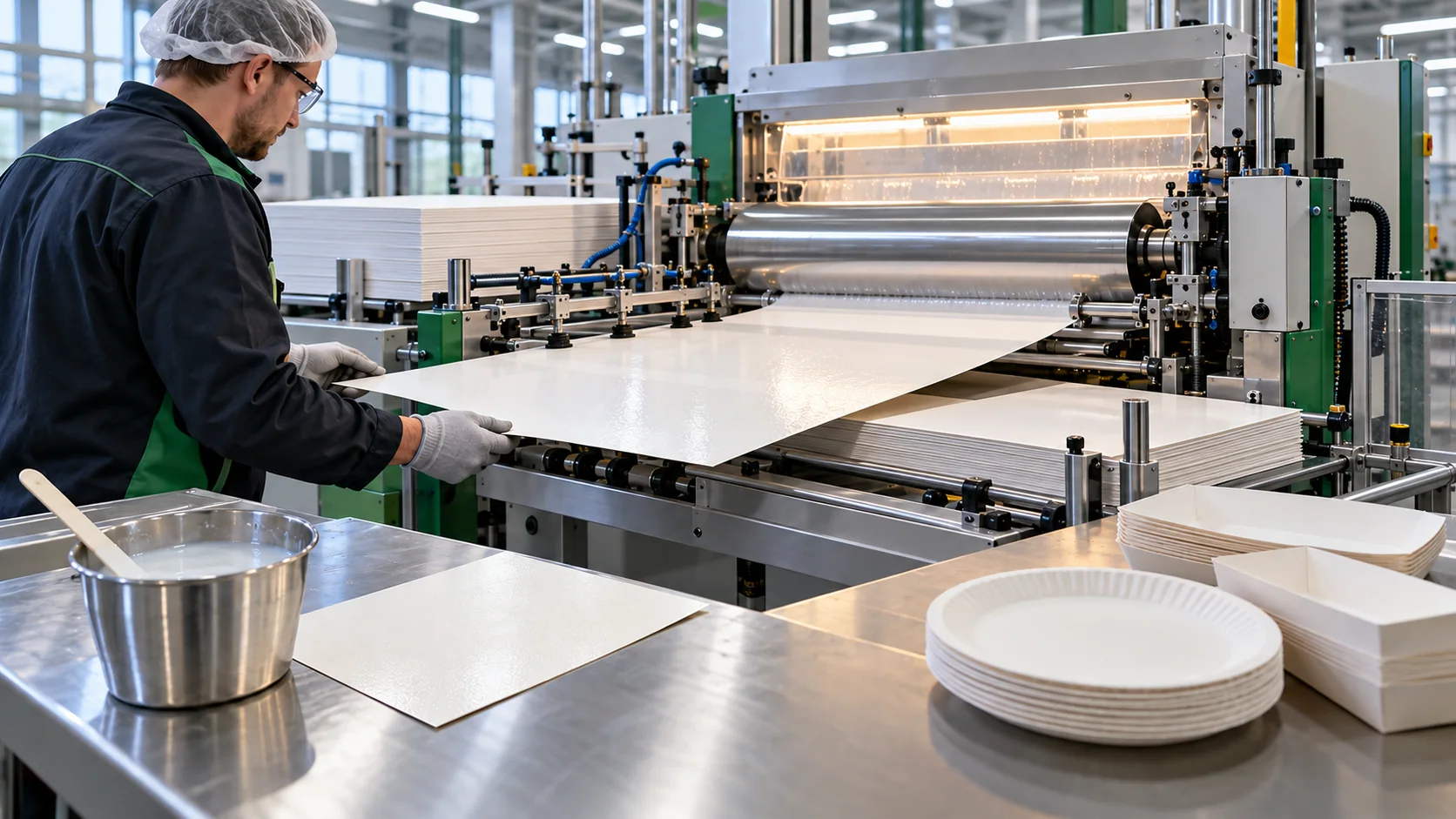
Our coating liquid can be adapted around existing sheet-fed varnishing, coating, drying, die-cutting and forming operations. The goal is to turn regulatory transition from a complete equipment-route change into a controlled upgrade of material, coat weight, drying and quality assurance.
A European customer has used our coating as the barrier layer of a paper plate and submitted the finished article to TÜV for EU food-contact migration testing, with a passing result. This is verifiable project experience. It is not a blanket guarantee for every substrate, formulation or application, and it does not replace PPWR PFAS-content testing or recyclability assessment.
For defined projects, LVTU can support customers with material descriptions, recommended process windows, batch information, relevant test documents and finished-pack validation plans.
Conclusion: PPWR readiness is an evidence system, not a material slogan.
PPWR moves the packaging market from environmental claims toward demonstrated structure, process and performance. The value of LVTU’s water-based coating is not merely replacing a conventional varnish or plastic film. It is helping paper-product manufacturers develop a lighter, more documentable material pathway toward PPWR requirements while retaining familiar converting processes.
We welcome paper converters, varnishing companies and food-packaging manufacturers in Europe and worldwide to run joint trials with their actual paper, equipment, food application and destination-market requirements.
Contact LVTU Packaging · Phone: +86 156 5560 0006 · WhatsApp Business: +86 181 7737 8866 · Email: lee@lvtupack.com