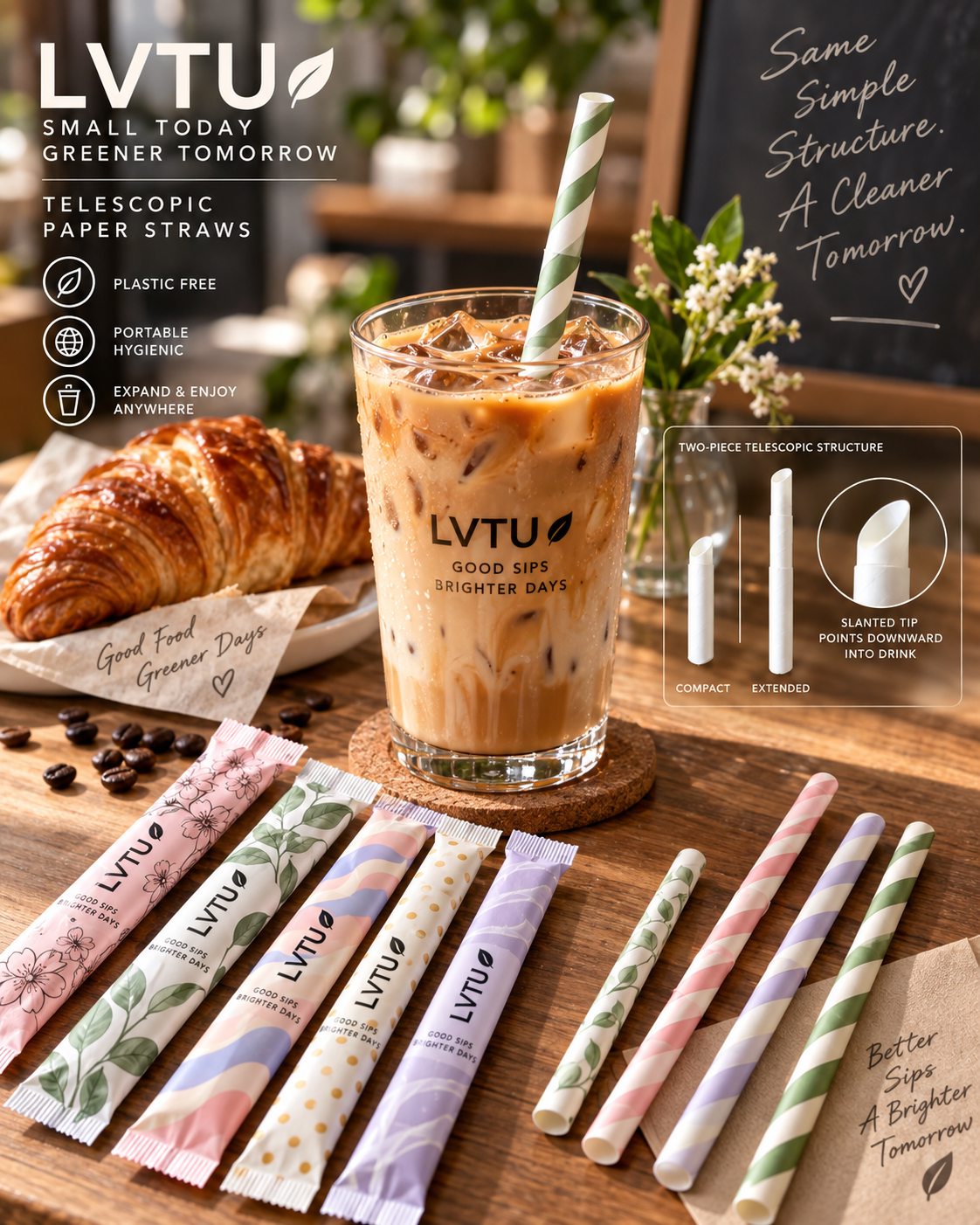
The useful length of a straw changes during its journey.
During converting, wrapping, packing, transport and pack attachment, a long straw can be inconvenient. During drinking, the same straw still needs enough reach. A telescopic structure separates those two needs: compact before use and extended for drinking.
The format uses two paper tubes with a controlled connection. Its value is not complexity; it is the ability to match a shorter packed state with the drinking length required by the beverage format.
Scenario 1: cup-side and in-lid ready-to-drink beverages.
Milk tea, iced coffee and other ready-to-drink cup formats need sufficient drinking reach, but a conventional long straw may extend beyond the printable or attachable area of the cup. A compact telescopic format can be explored for cup-side attachment, in-lid storage or single wrapping.
For the project team, the key checks are collapsed and extended length, wrapper size, attachment position, extension force and the customer opening sequence.
Scenario 2: particle drinks that need a wider path.
Bubble tea, smoothies, yogurt drinks and drinks with pulp may require a wider internal diameter than a standard beverage straw. A large-diameter telescopic format can combine that drinking requirement with a more compact packed length.
Diameter, wall structure and connection design must be assessed together. The right result depends on particle size, beverage viscosity, temperature, expected drinking time and the intended user experience.
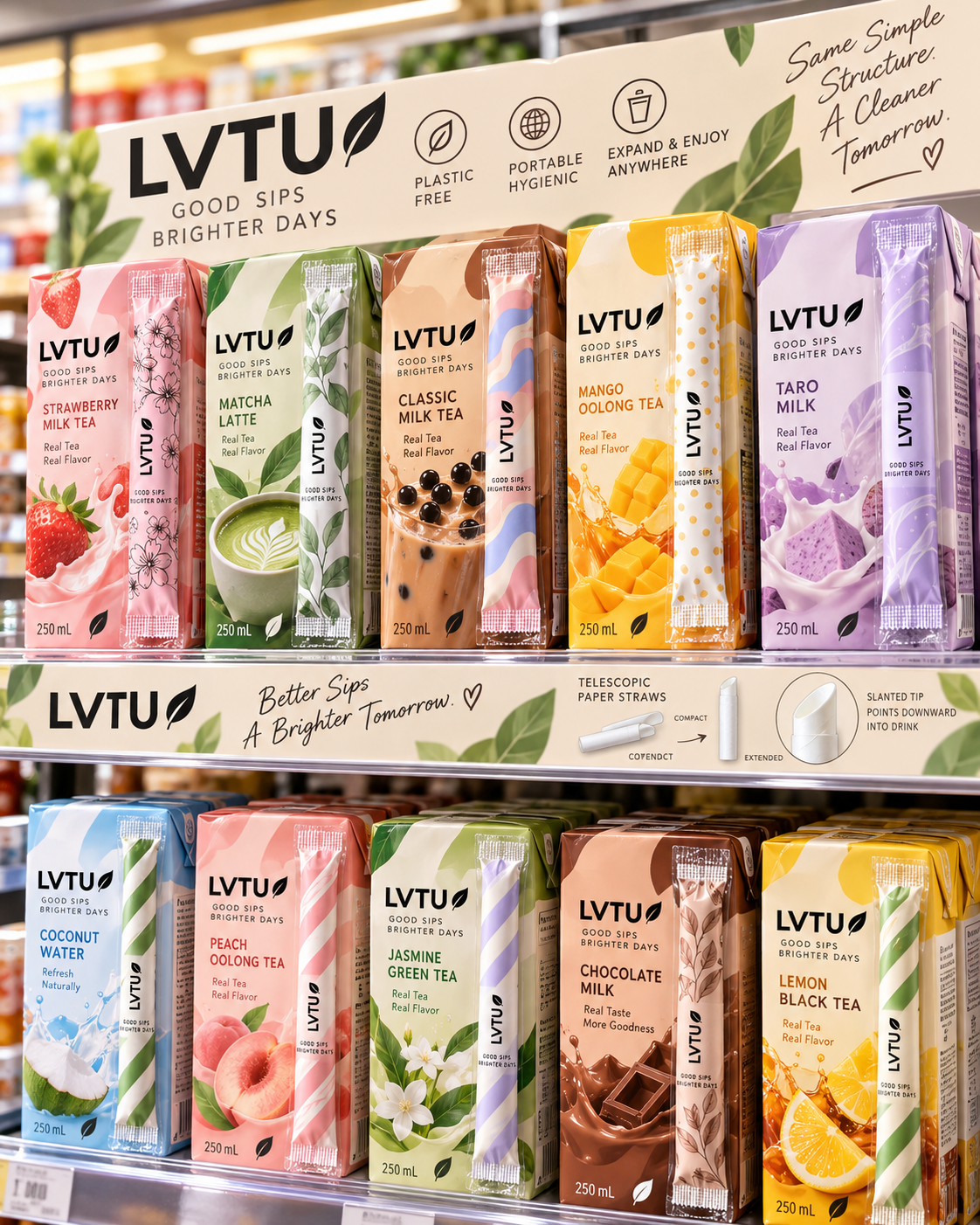
Scenario 3: cartons, dairy and juice packs.
Carton-side attachment is where compact length can become especially relevant. A shorter packed straw may provide more freedom when the available panel is limited, while the extended state can still reach into the beverage pack.
This is not an automatic line-fit claim. Wrapper geometry, adhesive area, pack surface, puncture method and compatibility with attachment equipment all need to be trialled on the real pack.
Scenario 4: retail kits and brand-led drink experiences.
DIY drink kits, promotional packs and retail multipacks can use the pull-to-extend action as part of the product experience. The compact format is easier to arrange in a kit, while the visible extension gives customers a small moment of interaction.
Printing, colour and individual wrapping can support brand recognition, but food-contact suitability and functional performance must still be evaluated for the final construction—not inferred from appearance.
The advantage is a better fit between product and packaging.
A telescopic paper straw can offer a compact packed footprint, full drinking reach, a straightforward two-piece structure and more options for pack attachment or retail presentation. Those advantages are strongest when they solve a defined packaging constraint.
A useful trial therefore starts with the beverage, cup or carton, target lengths, diameter, wrapper, serving time and line conditions. LVTU can turn those inputs into a sample specification and a project-specific validation path.